Data Centres & Class
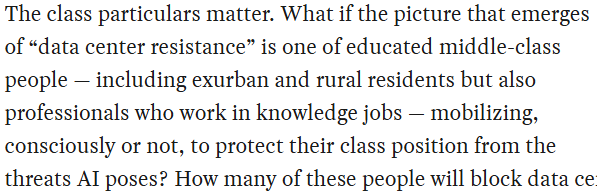
Having just read this article by Holly Buck I'm immediately trying not to be too scornful. The gist of it is that resistance to data centre construction is a: a privileged, NIMBY past time and b: a middle class (in the UK sense) limitation of access to AI 'tools' that they can afford but which they deny the working class by keeping access to them as a pay to play, premium option. Brian Merchant has written a good rebuttal to it already but I also wanted to throw on a couple of my own criticisms which may crossover a bit but seem worth making all the same.
Starting with the first part... As Merchant points out in his reply it just doesn't seem to hold up. In the UK as well as the US data centre opposition seems to draw from a broad cross section of society and, generally, seems well informed about the impacts of pollution, extraction and corporate monopolisation of infrastructure. No doubt there are NIMBYs who oppose them on principle and for reasons more personal than practical or political but in this instance their objection still crosses over with reality. There is very little value to any community to have large scale data centres dropped in the middle of them. On an immediate level there is the pollution, effects on local services (energy and water) and there is no real incentive as far as jobs go because data centres just aren't massive employers beyond during the construction phase. On top of that the broader effects of the AI rush we're seeing are still detrimental in myriad ways, but I'll get to those in a moment.
The other aspect of resistance highlighted in the article is the slightly incoherent nature of the alliances being build to make up the opposition. As I mentioned the other day there are emergent fronts which cross Left-Right divides and which include incredibly disparate groups from right wing conspiracists to left wing revolutionaries. This absolutely can be problematic insofar as the message that emerges from the opposition can become a diluted one, unable to frame a coherent political position because every voice pulls in a different direction and ends up falling far short of any real, structural solutions to the issues AI purports to solve. I don't think the answer to that is to bemoan the broadness of the front though and it's certainly not to oppose it in favour of AI accelerationism. As these spaces of resistance emerge it's more a task of influencing them, promoting clear political aims beyond the immediate which point in the right direction (whatever you may consider that to be). Certainly lamenting the widespread enthusiasm for opposition as some kind of corrupted crossing point is a poor approach to resistance in this, or any, movement.
There's also the issue of the immediate concerns. If a data centre, along with its attendant harms, is being imposed on your area then the consistency and purity of the opposition to it becomes a bit of a secondary issue. The struggle is the struggle, the need to assert local agency and protect your environment (human and natural) is the priority. It's always going to be a little patronising to have commentators appear to say 'you're doing organising wrong' in the face of that.
The final point on that aspect of contextual opposition is the suggestion from the article that in rejecting it in what the author calls 'more affluent areas' there's a push to relocate those data centres overseas - which leads to the corollary thought that's often mentioned - it'll just be built where it's easier for these corporations to impose their will. And it's true, a victory in one context doesn't necessary forestall the construction of new, extractive infrastructure. If the movement to oppose that building is viewed purely as a NIMBY exercise in self interest then that problem does gain force but again I think to assume it's just that is a misreading in itself. The solution to the displacement of harms isn't to accept those harms, it's to globalise the issue - you may not carry everyone with you from a local concern to an internationalist sense of solidarity in opposition but if you are on the resistance side then you can certainly attempt to draw as much of it as possible forward from one struggle to the next. As with the question of toxic alliances - the problem is not a defeat but another aspect of the struggle.
The second strand of the article is around access to the 'tools' of AI where to hinder infrastructure roll-out is to deny access to the platforms for working class users. The author cites their own uses for LLMs in education and legal issues but, as ever, the cure from AI is generally no cure at all.
I can't speak for the US higher education system but certainly in the UK the hyper-commodification of HE and the hammering effects of perpetual austerity are perhaps the core drivers of AI adoption by both students and misguided institutions. Platforms are presented as the workaround to problems that nobody currently cares to fix. For the Left to accept that as valid, to abandon the drive for structural change in exchange for a proliferation of corporately owned, centralised fixes which paper over the gaps seems like a massive defeat - for the master's tool will never dismantle the master's house. It's not a great victory to secure access to the tools that inherently exploit and displace as a way to endure a system that perpetuates both things. Similarly, with the legal example offered where advice on immigration issues is so massively over-priced as to be completely unjust offering a momentary means to navigate that broken system isn't a positive step, it's an inherent defeat and acceptance of that system.
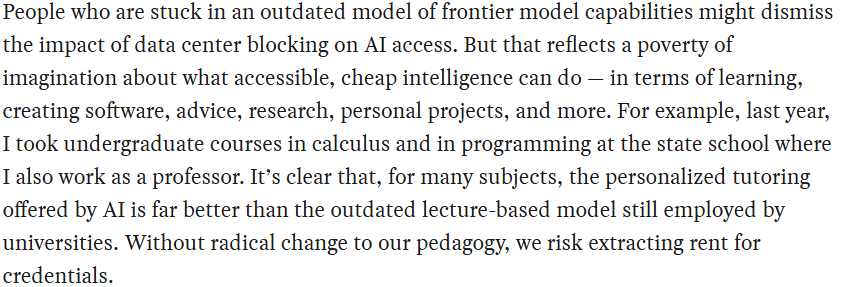
I accept that, in the moment, those workarounds created by AI may be necessary for those most in need of ways to evade the structural problems but 'the system is so bad that I have to dodge my way through it' should never be a political position for the Left or anyone else.
Finally, when people talk about the democratisation of access, there can be no escaping what it's access to. What we have with corporate AI is harmful. It's based on theft, non-consensual data usage, attention and attachment manipulation, deskilling, labour exploitation, profiteering, cultural erasure and centralising, authoritarian impositions of meaning. Those issues don't fade away even if you do somewhat open access by handing free reign over to the biggest, most toxic corporations - even if the fantasy is valid then trickle-down AI is no more progressive than trickle-down capitalism. Access to a system designed around harms and exploitation doesn't lead to systemic change. The author does call for legislation and reform in the hope of drawing the power away from those corporate actors but it's hard to square that with the reality we currently inhabit. Even if you do believe in the potentials for redeeming the broad set of technologies that AI represents then granting more infrastructural power to its worst advocates with a vague gesture to potential change seems optimistic at best. If the legislation for limiting those platforms and their build-outs were in place already then, well, I'd still be anti-AI, but certainly saying 'let them go for it' on the assumption that further embedding their power will leave a gap for reform just seems like a forlorn hope.
Ultimately, where the article talks about the class conflicts around AI and the data centre roll-out I think the battle ground chosen is simply wrong. Going back to Lorde and the Master's tools we can't get caught up focusing on access because, in the end, we won't even be looking at the right fight, never mind the right battleground.
- Dylan