Monday AI Resistance Update #10
A random sampling of stuff I've come across this week... A day late this time because we had a Bank Holiday here alongside a heatwave, so who wants to be thinking about AI?
--
Created by We & AI, DAIR, the Refugee Law Lab and working with Karen Hao the AI Resist List is something I've already mentioned this one on the blog but it's worth bringing up again. This has been a major effort lead by Tania Duarte over at We & AI, a group I'm affiliated with myself. It's an ambitious attempt to organise disparate critical and resistance groups, allowing them to connect, find new supporters and share information. It often feels like the networking of resistance actors around AI is incredibly chaotic, if I know of one or two groups myself then they can be completely unheard of by the next person I speak to. Tactically there is some value in that, from an everyday perspective anonymity or communal insularity can have its benefits, but some things don't benefit from obscurity and even if broader organising can bring the risk of reaction there's not much use in operating in isolation when the benefits of collaboration can be far greater.
Anyway, definitely a project to keep an eye out for moving forward.
Another one I'm involved in and a bit parochial (for now) but a few people at King's College London have started (unofficially) organising around critical and anti-AI ideas. For now it's focused on that specific institution but we're hoping the projects we develop can be transferable and that, in time, we can connect with other HE institutions to organise and share knowledge.
The narratives of inevitability and hype around universities are nearing fever pitch even as opposition to AI becomes ever more prevalent. They also make an obvious focus for tech companies given the years of austerity in HE, FOMO and mismanagement fixated on the ongoing commodification of education. Like a less evil version of defence, education contracts are a staple of warding off the looming crisis of unprofitability around AI companies. So, one to have a glance at if you're in the field (or just generally interested in it).
There's a lot in this one - Pope Leo XIV has put out an encyclical on AI which, in a lot of ways, speaks to the same themes as those of us on the resistance side do. Straight off it jumps into biblical passages outlining AI as both a socio-technical issue and calling for a community led reaction to it, anathema to the current drive for tech bro egotism as the guiding force. It isn't exactly abolitionist, but even in those two points it pushes more moderation than we've seen in a long time from any mainstream voice.
At the same time however Christopher Olah, co-founder of Anthropic, was sat in the front row for the launch giving out the usual 'we're not evil and deeply appreciate ethical criticism line'.
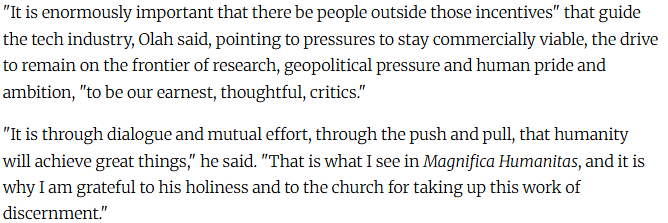
Anthropic especially go in for this sort of thing, with their in house Philosopher and apparent concern for the rights of (non-existent) sentient AI but frankly it always comes across as entirely hollow. There's an abundance of AI criticisms out there, academic, political, activist, labour related - it doesn't take the Pope to frame those issues - but Anthropic, like most other companies, has shown a routine indifference to those critiques especially when they offer any hint of limiting what they can do with their technologies. Accountability and ethics make for great balms for a troubled tech worker but if they don't come with actual, structural limitations and changes then the talk is just that, talk.
What hope the Pope has of moderating tech companies I've no idea, maybe he's hoping Elon Musk and Sam Altman have souls to save although I'd be less sure about that myself but practically speaking we've seen how surface level tech companies are when it comes to ethical arguments. They may like to nod to them but they seldom change course for them.
Anyway, I might do something a bit more in depth on the encyclical another time (and other religious resistances for that matter) but certainly a notable story for the day.
Article - How Deepfakes Tore a High School Apart (Paid)
Sorry for the paid article but the story is far from a new one. Nudification and deepfake apps have been raising all sorts of issues in schools (and everywhere else) for a while now and while some places are slowly catching up and moving against them it's far from a resolved issue.
At this point they remain available on Apple and Android stores, as well as being marketed on social media (along with other, deeply problematic sexualised AI) and where institutions do react it's usually through older laws and guidelines being torturously drawn out to cover new harms.
This story in particular relates to the US but it's far from a localised issue, in fact in some parts of the world the harms could be considered even more dramatic as the suggestion of 'impropriety' on behalf of women or girls can lead to devastating ramifications, even when the content is entirely fake and non-consensual. Which isn't to diminish the experience of those victims in the US at all - non-consensual sexualisation has been and remains a form of abuse in my opinion. That tech companies and AI exponents have so often sought for arguments to dismiss that speaks to deep and enduring issues around the technologies they operate and promote.
As always here the impulse is to push the victim to change their behaviours. Echoing the 'well if you dressed modestly' stuff which has always been around victims here are expected to, somehow, mitigate their own risks of exploitation through AI technologies. We should dismiss that one immediately. The victim isn't accountable for the crimes of their abuser and there is no negating the potential harms of AI - any picture, taken knowingly or unknowingly, can be manipulated and used to generate deep fakes. Short of absolute withdrawal from life there is no way to avoid the potential for those harms.
We also see the echoes of old issues here, boys infantilised to the point of being unable to judge their own behaviours, institutions marginalising and burying issues of sexual harassment and abuse. While the stance on both things seems to be, for now, that every issue should simply be re-litigated in the light of AI technologies the lack of real pressure for change remains.
That Google and Apple allowed for the sale of these apps, that tech companies allowed for technologies that enabled them, that boys and men assume their use is acceptable - these aren't issues broached by retroactive, partial legislation. And even where the vague moves towards legal changes are made access to justice will always be a minority pursuit, whether that be because of financial constraints, social pressures or police ineptitude and bias. If we want to forestall this issue before it proliferates even more now is the time to take action and, from an AI focused perspective, the biggest step would be to bring the hammer down onto companies who build and profit from platforms that have no purpose but to exploit, regardless of the impact on their profit motives.
--
Anyway, on that cheerful note I'll wrap things up for the week. Not much to report this week but certainly some interesting bits and I've managed to go a bit more in-depth than usual. Until next time.
- Dylan