Monday Resistance Update #2
A roundup of some resistance relevant things I've noticed through the week, a long way from comprehensive. Articles, papers, podcasts, news etc. If anything comes up that you think should be added just get in touch.
--
Article - UK Government Backs Down on Opt-Out Nonsense
A victory that should never have had to be won, because it was a very obviously stupid and harmful idea, but the Starmer government has backed down on the idea of an opt-out system for creative data theft.
Not to be a perpetual cynic when the news is good but I'd be incredibly wary of thinking that the government that had the idea has somehow seen the light in turning away from it. There was huge public push back, including from people notable enough to matter in their eyes, and that's what's forced the change. What it can't force however is for them not to have another just-as-bad plan in the future which they can try to push through with less attention being paid.
Also worth noting that in their report there's talk of a new Creative Content Exchange which, to be honest, sounds like a government lead Temu for bad data, because I can't imagine anyone voluntarily offering up real creative content. How opting into that will work is an interesting question, especially if permissions can be given at company/institutional rather than creator levels.
Anyway, good news is good news so I won't be too down on it and full credit to all of those who made the noise and fuss that got it stopped.
I wrote about the protest in London a few weeks back where Pause AI and Pull The Plug took the lead on organising and it wasn't a unique event. In San Francisco this weekend there was another, similar, march which I'm guessing was down to Pause AI given the almost identical plan for it - standing outside closed offices on a weekend chanting.
I really have a dim view of Pause AI as a group, something I will write about at some point, and the events they appear to have a hand in seem universally... wet, to put it politely. But I will say that I don't think they're actually representative of those attending (although numbers for this one didn't look great, 100~ reported post event). I think they're drawing in a fairly wide audience even if their fixation is Doomer xrisk rather than anything that's actually impacting people now.
How important a mass protest front really is I'm not sure, my focus is on the everyday and I think a heavily decentralised, chaotic resistance would be far more effective initially at least but it is a thing to think about. Not just what level of effort or organising should go into that sort of 'mass' protest but also what messages should be at the forefront of them. Stop The Race, co (or core?)-organisers of the SF protest say this on their website...
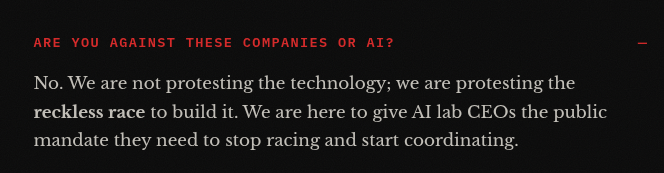
I think that's problematic in a couple of ways - for one a lot of us are protesting against the technology and for another a lot more people really have no interest in or hope for mobilising the ethical concerns of tech billionaires. Anyway, that's a debate for another time.
Strike - 2,400 Kaiser mental health professionals strike in Northern California over AI concerns
On to a more clearly positive action - 25,400 Kaiser healthcare workers went on a one day strike over issues around AI. Their concerns are pretty widely echoed in my experience - AI is a tool of enforcing time austerity, what it can get done badly frees up workers to churn through patients. What's lost in something being done badly is of secondary - or more likely no - concern to the companies involved.
I've spoken to NHS workers here who are using AI for things like patient notes and it can be a tough discussion to have. Resources, including time, have been eroded down to bare minimum levels and it can easily feel like there is no option but to use the tools pushed by management. How can that be countered? I'm not in a healthcare context so I can't speak to what emergent tactics there are there (although do let me know if you're involved enough to know) but as a patient I have asked my GP if they're using AI for notes before. As it is, in relative good health, I could afford to argue on something like that and say I didn't want it used but obviously the more acute your problems the less viable that can be, especially when saying no can lead to delays in treatment. Still, it's another thing to be wary of as you think of your healthcare - not just because of potentially extractive practices around your details but also because of what's lost when the machine rather than the human is paying attention. I've seen doctors write before about the craft of writing up notes as an important aspect of understanding a patient and that rings true, care requires time, even if that time is spent on sometimes dull work. Erasing time all too often means erasing care.
Anyway, all solidarity to those Kaiser workers.
Article - Alex Reisner -The Hypocrisy at the Heart of the AI Industry
Probably nothing new to the initiated but a concise outlining of the hypocrisy of Silicon Valley's theft machine (stealing for me, but not for thee) which adds nicely to the chorus. Also contains a nifty clip of Eric Schmidt, former Google CEO, saying the quiet part out loud.
Article - Megan Farokhmanesh - Tinder Plans to Let AI Scan Your Camera Roll
A while ago I wrote about Reconsidering Our Tech and seeking out better tools (or no tools at all) as we manage our digital existences and data. One thing I didn't suggest any alternatives for is dating apps and, I suspect, there probably aren't going to be any good ones. As Tinder trials full AI access to all of your images though I think it's probably safe to say that they're not the one to go with for your idle left and right swiping. As with social LLMs and the risks surrounding them dating apps are a space where the biggest solutions - more social spaces, community stability, financial freedom etc - can seem profoundly unreachable at this point in time. So how you avoid the invasive, extractive practices they're leaning into is a good question and, beyond personal, sometimes detrimental, choices, it can be hard to see an easy path there. No answers to that, just a thought.
- Dylan